The GAERS Framework
The GAERS Framework: Rethinking Agricultural Advisory for Rural Nigeria
The GAERS Framework: Rethinking Agricultural Advisory for Rural Nigeria
At the heart of Global Agricultural Extension and Rural Services (GAERS) lies a simple but bold mission: to close the information and advisory gap that millions of smallholder farmers in northern Nigeria have lived with for decades.
Nigeria is Africa’s largest economy, yet for the farmers who form its backbone, access to credible knowledge remains a struggle. The extension system is overstretched, underfunded, and often absent in the very places it is most needed. The result has been predictable: an overreliance on synthetic chemicals, declining soil fertility, poor food quality, and cycles of poverty that trap rural households.
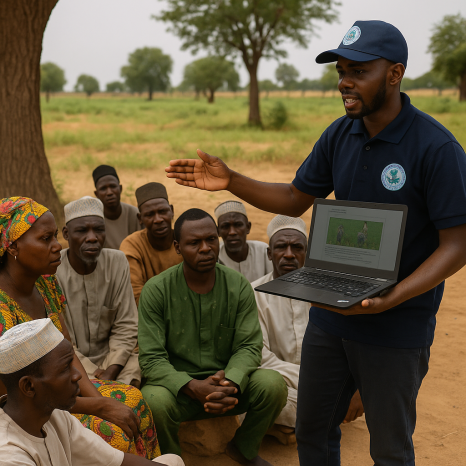
GAERS emerged as a response to these realities. Rather than building parallel structures, we chose to work with what exists—revitalizing state agricultural institutions and empowering extension agents who had long been sidelined. Today, more than 20 trained volunteers and agents are embedded in their own communities, lowering costs and increasing trust.
But agents alone cannot carry the burden. This is why we also work with Farmer Champions—trusted local leaders who bring credibility, help onboard farmers into our groups, and flag urgent issues like the onion seed crisis. Together, this dual network of agents and champions ensures that advisory support is not just available, but also trusted and contextual.
Our choice of technology is also deliberate. While the world speaks of agri-tech in terms of sophisticated platforms, we embraced WhatsApp—because that is what farmers already use. Through seven active groups, GAERS now reaches over 700 farmers and agents across Sokoto, Kebbi, Borno, and Katsina. These groups are not just bulletin boards; they are living communities of practice. Farmers share experiences, agents provide clarifications, and experts answer questions in real time. We share videos translated into Hausa, simplified infographics, step-by-step guides, and even audio lessons for those with limited literacy.
And most importantly, we listen. Farmers may not always articulate “lack of information” as their biggest challenge, because many have never experienced reliable advisory services. Yet through our surveys, workshops, and WhatsApp dialogues, we uncover deep needs—ranging from sustainable soil management to the urgent inclusion of women farmers who are often left behind.
In practice, this has meant co-organizing workshops on soil health with Farmlab Yeranda in India, working with the Federal Ministry of Agriculture to deliver fertiliser training in Hausa, and even developing GAERS-branded safety guidelines to protect our volunteers in the field. These are small steps, but each one redefines what advisory services can look like when they are locally led and digitally enabled.
Of course, challenges remain. Sustainability is the most pressing. Our services are free to farmers—but who pays for this in the long run? Should donors fund not just technology but also the outreach and facilitation that make it work? Can private sector actors join forces to build models that endure? These are not abstract policy questions for us—they shape whether smallholders will continue to access reliable knowledge in the years ahead.
Looking forward, GAERS is building towards a permanent Farm Lab in Sokoto, a hub for demonstrations, training, and innovation. We are also exploring mentorship models where early trainees guide others, supported by ongoing training and modest stipends.
For us, the future of agricultural advisory in Nigeria cannot be built on top-down programs alone. It must be co-created—with agents, with farmer champions, and most importantly, with the farmers themselves.
At GAERS, we believe that with the right mix of digital tools, community trust, and farmer-led content, rural Nigeria can reclaim its soils, its harvests, and its future.
About GAERS
The Global Agricultural Extension and Rural Services (GAERS) is a grassroots-led initiative improving the quality and accessibility of agricultural education for smallholder farmers in Nigeria.
Our mission is built on:
- Digital-first, community-led advisory services
- Training extension volunteers and farmer champions
- Providing local-language resources in Hausa and other languages
- Connecting farmers with credible knowledge and market access tools
Through WhatsApp-based platforms, hybrid workshops, and cross-country partnerships, GAERS is proving that inclusive, low-cost, and farmer-driven advisory models can transform Nigerian agriculture.
Learn more: GAERS Framework